‘Advocacy and Learning: The Positive Statewide Impact of AASG’ by Francis Meyers

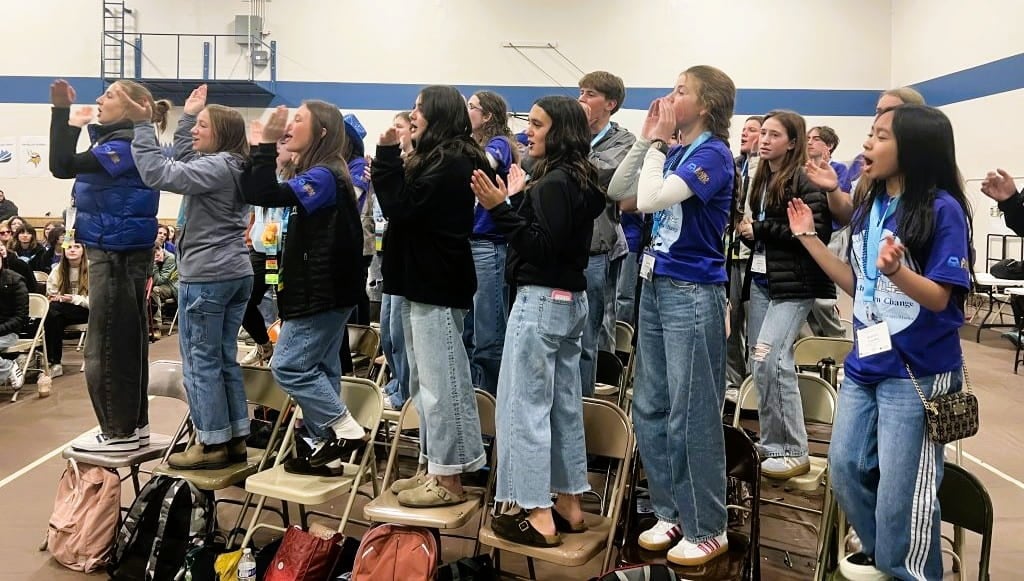
Once a semester, hundreds of student council leaders from across the state come together at the Alaska Association of Student Government’s conference. This conference, dubbed AASG, is always a blast to attend–with the 300+ delegation engaging in workshops, fun individual challenges, and spirited competitions between the six Alaskan regions.  Continue reading ‘Advocacy and Learning: The Positive Statewide Impact of AASG’ by Francis Meyers

‘Growing Artists in the Mat-Su Valley’ by Anna Folsom

Palmer High’s International Baccalaureate (IB) Visual Arts students participated in the Palmer Arts Council Fall Studio Tours, engaging directly with the vibrant local arts community. This was the first year of studio tours and it was a great success for artists and visitors alike. Community members were invited to visit different artists’ studios, observe their creative processes, and experience art-making in real time. Multiple art mediums were demonstrated in painting, metalwork, charcoal drawing, fiber arts, sculpture, ceramics and pottery. Artists opened their studio doors willingly, and over 200 people participated in the tours. Continue reading ‘Growing Artists in the Mat-Su Valley’ by Anna Folsom

‘How Shared Leadership is Raising the Bar for Alaska Schools’ by Superintendent Robyn Taylor

In Petersburg School District, we’re seeing how empowering teacher leaders, working in partnership with school leaders, makes a lasting difference. Through our partnership with the National Institute for Excellence in Teaching (NIET), we’re building a culture where teachers lead learning, support one another, and grow together. This shared leadership structure has improved collaboration, strengthened instruction, and is helping us retain great teachers — all of which are essential in a small, rural district like ours. Continue reading ‘How Shared Leadership is Raising the Bar for Alaska Schools’ by Superintendent Robyn Taylor

‘Nunalleq Digital Museum – An Accessible Resource for Learning about Yup’ik Pre-Contact History’ by Prof. Charlotta Hillerdal

We live in a changing world. This could not be more obvious to the Yup’ik communities that were hit by the aftermaths of Typhoon Halong on October 12th – with disastrous consequences to people’s homes and lives. In the sorrow that follows this, it has become apparent what immediate threat climate change poses to the Yup’ik way of life.

In Quinhagak, the storm not only attacked boats and fish racks, water and sewage infrastructure, but also the ancestral site of Nunalleq, an Old Village dating back c 500 years, to a time before Europeans came to Alaska. It brought destruction to parts of the historic site, displacing thousands of artifacts on the beach.

Fig. 1. Wooden figurine on the beach, eroded from the Nunalleq site after Typhoon Halong, October 2025. Photo by Rick Knecht.

Continue reading ‘Nunalleq Digital Museum – An Accessible Resource for Learning about Yup’ik Pre-Contact History’ by Prof. Charlotta Hillerdal

‘Reviving Tradition: Building an Ulux̂tax̂ Aleut Canoe in False Pass’ by ACSA Staff

False Pass, or Isanax̂ as it is known in traditional Aleut, sits on the eastern of Unimak Island in the Aleutian Islands region of Alaska. This past spring a remarkable project unfolded in that blended tradition, education, and community spirit. Thanks to a grant from the Aleutian Pribilof Islands Community Development Association (APICDA), False Pass School welcomed two professional carpenters to lead a hands-on boat-building initiative. The goal? To construct an Ulux̂tax̂, a traditional two-person Aleut canoe, and in doing so, reconnect students and families with a vital piece of their cultural heritage. Continue reading ‘Reviving Tradition: Building an Ulux̂tax̂ Aleut Canoe in False Pass’ by ACSA Staff

‘History Has Never Not Been Important’ by Stephanie Meek

Stephanie Meek is the 2025 Alaska James Madison Fellow

History has never not been important. Today is no exception. Students need history to understand the present as much as they need it to understand the past. The skills taught in history, specifically what we like to call “thinking like a historian,” teaches students to not just think critically, but it teaches them the purpose and importance of doing so. Learning history teaches students about contextualization, analyzing sources, continuity and change over time, cause/effect, how to make comparisons, and how to effectively develop an argument. All these skills transcend the discipline and are essential to all other areas of studies/subject matter. Today, students have more access to unverified resources than at any point in history and history classes provide students the skills needed to evaluate information (consider origin, purpose, content) and come to evidence-based conclusions. History reminds us that we are all connected and because of that fact, there is an intrinsic value in looking at multiple perspectives. All these components of learning history are why it is important for students to learn it. Continue reading ‘History Has Never Not Been Important’ by Stephanie Meek

‘The Alaska Arts Education Data Project’ by Sam Jordan

It has been proven time and time again in countless studies that students who actively participate in arts education are twice as likely to read for pleasure, have strengthened problem-solving and critical thinking skills, are four times more likely to be recognized for academic achievement, four times more likely to participate in a math and science fair. -Quincy Jones

In‬ 2023‬ the‬ National‬ Endowment‬ for‬ the‬ Arts‬ and‬ Alaska‬ State‬ Council‬ on‬ the‬ Arts‬ awarded‬ funds‬ to‬ the‬ Alaska‬ Arts‬ Education‬ Consortium‬ to‬ investigate‬ what‬ was‬ happening‬ with‬ arts‬ education in Alaska.‬ Since that time, a cross-sector team of Alaskans, including educators, artists, Alaska Native culture bearers, legislators and health officials, has been working to get to the heart of the question: Which students, where in Alaska, and how are students in Alaska’s public schools experiencing arts education?

Student self-portraits from across the Lower Kuskokwim School District, Bethel, AK

Continue reading ‘The Alaska Arts Education Data Project’ by Sam Jordan

‘Alaska Youth Lead the Way: Six Honored for Positive Community Impact’ by Alaska Communications

Across Alaska, young people are tackling real issues, like fighting food insecurity, advocating for mental health, expanding access to youth sports and the arts, and creating more inclusive communities.

This summer, through a program called Summer of Heroes, Alaska Communications and Boys & Girls Clubs of Southcentral Alaska are recognizing six exceptional young Alaskans. Continue reading ‘Alaska Youth Lead the Way: Six Honored for Positive Community Impact’ by Alaska Communications

‘YKSD Creates Place-Based Math Task Database’ by Bobbi Jo Erb

“…the Alaska Cultural and Alaska Mathematics Standards combine to create relevant, engaging, and rigorous math learning.”

How long does traveling from Allakaket to Hughes by snow-go vs. boat take? Why is the distance traveled different for these two situations? How much further to go by boat? These are the types of questions Yukon Koyukuk School District (YKSD) students will tackle in math classes as teachers begin using the YKSD Place-based Math Task database. YKSD educators developed this database during spring break Place-based Math workshops. Continue reading ‘YKSD Creates Place-Based Math Task Database’ by Bobbi Jo Erb